
Project example: a 75-inch TV on a tilting mount low on a vaulted wall, with the wires inside the wall — what it looks like and what it costs
TV Mounting House Mission Viejo walks through a typical tall-wall project in Pacific Hills: a 75-inch TV on a tilting mount hung low on a vaulted living-room wall, with an in-wall rated cable run down to a cabinet and the height set from the sofa rather than from the ceiling.
Bookings aren't open yet. Leave your name and number; your message is recorded, and you'll get one message when a local installer is available.
Worked example. The pictures are AI concept illustrations, not photographs; no installation was performed or arranged through this site; prices are typical Mission Viejo area market ranges, not quotes.
 Illustration
Project Examples & Typical Prices
The scenario
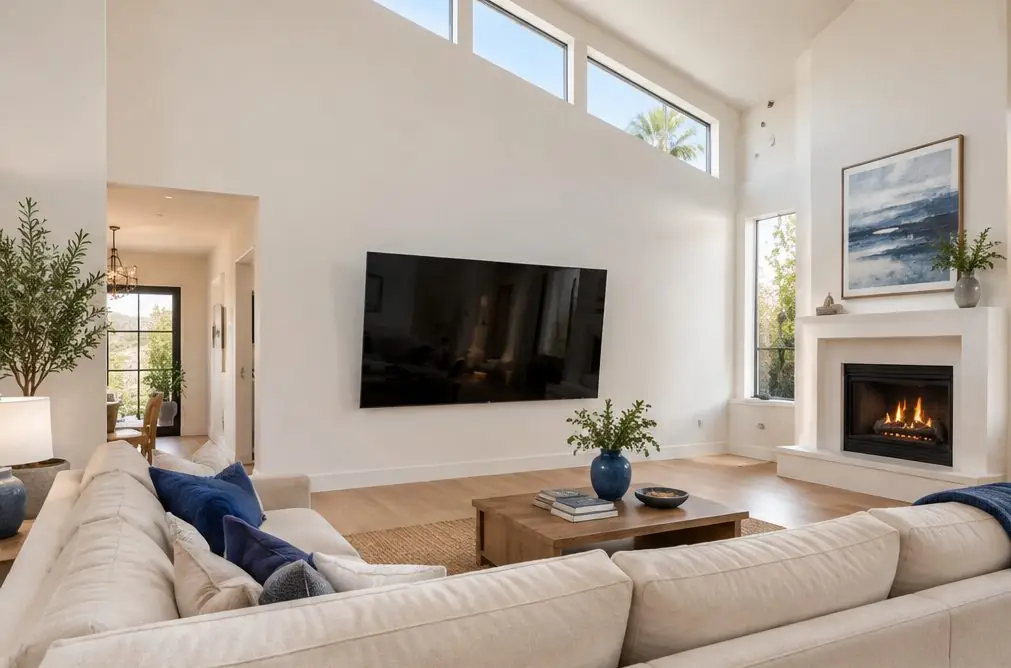
The living room is a double-height space with a sloped ceiling that peaks over a long white wall. A row of small windows runs high up, a gas fireplace sits off to the right and a linen sectional faces the wall from the middle of the room. A console against the wall below holds the streaming box and speakers.
The request is a 75-inch TV on the long wall that reads comfortably from the sectional, with no visible cable and no ladder visit needed to change anything afterward. The first instinct is to hang it midway up the wall, where the eye lands on entering the room, but from the sofa that would put the picture high.
The plan hangs the screen lower, with its center near the eye line of someone seated, and a tilting mount adds a few degrees against the glare from the high windows. The cable runs from the back of the TV down the wall inside a stud bay to a plate above the console.
What the job involves
- The installer taps out the studs with a finder and confirms the bay that will carry the cable with a probe; the wall is clear of fire blocks between the TV and the console.
- Painter's tape outlines the screen and the sectional sets the height: the center lands near the seated eye line, well below the slope.
- Pilot holes go into two studs and the plate is fastened with lag bolts, with a plywood backer added because of the screen's weight.
- Two people lift the 75-inch set onto the brackets from a correctly set ladder, and the lock screws are tightened.
- An in-wall rated power kit and a CL3 HDMI cable are fished down the stud bay to a pair of plates above the console.
- The tilt is adjusted against the window glare at the afternoon hour, and the picture is checked from each seat.
Hardware and materials
- Tilting mount rated for 65–85 inch panels
- Lag bolts, a plywood backer board and a socket driver
- In-wall rated power relocation kit, CL3-rated HDMI cable and two wall plates
- Fish tape, a small camera or bent rod and a hole saw
- A ladder rated for the height and a second person for the lift
What it typically costs in the Mission Viejo area
| 66–85 inch TV, standard wall mount (labor) | $165–$245 |
| Hide the wires inside the wall | +$95–$160 |
| Typical total | $260–$405 (market range, not a quote) |
These are typical local ranges, not a quote or an offer; an installer prices the actual job after seeing the wall.
Add-ons often paired with this job
- Full-motion (articulating) mount — +$30–$55. A swing arm would let the screen turn toward the kitchen but needs stronger backing and a longer cable loop.
- Mount a soundbar as well — +$50–$85. A bar on the console keeps the wall clear.
- I need the mount supplied — +$40–$130. If the household has no mount, one rated for the size is added as a separate line.
Why it is done this way
A tall wall makes the middle of it feel like the right spot, and the neck tells otherwise. The seat sets the height: the center of the screen goes near the seated eye line, however much bare wall is left above it.
The tilt is for the windows, not the viewer. A few degrees lean the top of the picture away from the wall, which sends the light from the high glass toward the floor instead of into the viewer's eyes.
The cable has a long way to fall, so an in-wall rated kit and a stud bay do the work that a cord on the surface would do poorly. Standard power cords never go in a wall, and a new outlet would be an electrician's job; here the existing console outlet is used.
The scenario sits in the middle of the range, since the screen is large and the wiring is hidden, but the wall itself is plain drywall.
What would change the price
- A fire block sits in the stud bay and the cable has to use a second bay or a surface raceway.
- The ceiling slope or the windows leave no wall low enough, and a pull-down or swing arm is chosen instead.
- An 86-inch screen moves the base range to the top size tier.
- The household wants a second outlet behind the TV, which is electrical work for an electrician.
- A ladder cannot be set safely because of furniture, and the room has to be cleared first.
Where this leads
- Service page: Vaulted Living Room TV Mounting — Tall walls to the roofline, with the picture lowered to the seats and the cable drop planned.
- Local page: TV mounting in Pacific Hills
- All services and typical prices: TV mounting in Mission Viejo
- More worked examples: Project Examples & Typical Prices
Availability & price range
Check availability and the price range for this setup
Bookings aren't open yet — answer a few quick questions about the TV and the wall and get a typical Mission Viejo price range right here. Typical Mission Viejo prices for one TV, labor only unless an option says otherwise. This is a market estimate, not a quote.